Veganbaking.net
Vegan Baking Recipes
Vegan Frozen Dessert Recipes
Vegan Ice Cream Recipes
Vegan Vanilla Ice Cream
Vegan Vanilla Ice Cream

7
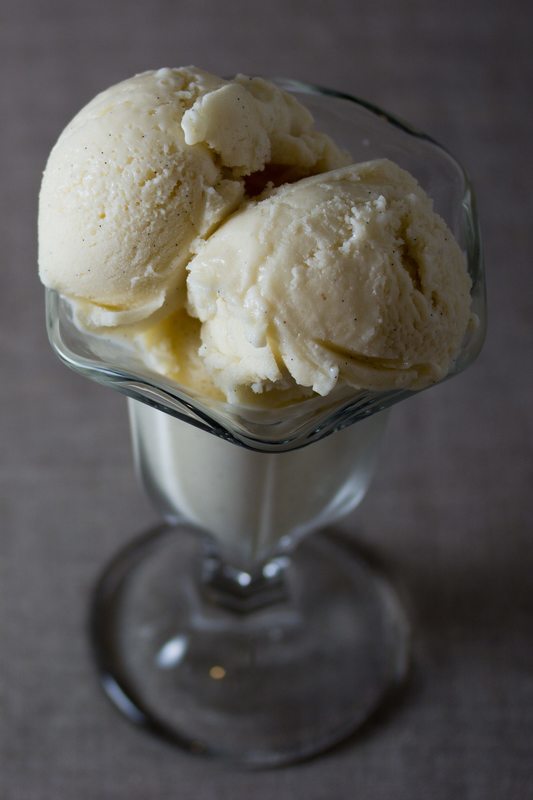
Few desserts are as satisfyingly simple as Vegan Vanilla Ice Cream. Over the years I've had dozens of different styles and I’ve developed a preference for what I believe to be optimal qualities in ice cream. I believe it should be rich, smooth, delicately melt into a creamy base in your mouth but not linger for too long and not have off flavors. I don’t prefer ice creams that are frozen into a block of ice, nor do I approve of ice creams that have the texture and taste of ice milk. So how do you develop a soft, creamy, flavorful vegan vanilla ice cream recipe without using eggs or dairy? While we're on the subject of ice cream, how do you develop an assertive vanilla flavor while not being over-the-top and making it taste artificial?
Dissecting Traditional Ice Cream
To understand our objectives in vegan ice cream making we need to go down to the microscopic level and find out what makes up traditional ice cream. Traditional ice cream consists of tiny ice crystals and air bubbles suspended in sugar, fat and milk protein, among other minor ingredients. The two most important factors in proper ice cream mouthfeel are:- The ice crystals need to be as small as possible in order for the ice cream to be as smooth as possible. The larger the ice crystals, the harder the ice cream becomes. The harder it gets, the less you’re going to taste it and the less it's going to melt in your mouth, coating your tastebuds with flavor. Think of how smooth gravel is compared to fine sand. This is ice cream ice crystals on a molecular level.
- Air bubbles need to be incorporated into ice cream to further enhance smoothness and promote lightness. The incorporation of air into ice cream is known as overrun in the ice cream industry. The percentage of overrun will cause your ice cream to yield more or less in quantity depending on how much air you incorporate. It’s actually a bad thing to have too much overrun because air doesn’t have any flavor. Incorporate too little air and your ice cream becomes too dense. Some low quality ice creams take advantage of high overruns to save money. Luckily, it’s nearly impossible to have a high overrun on a homemade vegan ice cream due to the difficulty that vegan ingredients have in holding air bubbles.
Designing Vegan Ice Cream with Smoothness and Creaminess
So keeping ice crystals to a minimum and holding some air bubbles are paramount in ice cream texture. In order to discourage ice crystal formation we can do the following:- Use fats because they act as a barrier to prevent ice crystals from joining together. Fat will also increase the perception of creaminess and fullness on your palate.
- Use corn syrup as part of the sweetener base. I know what you’re thinking: high-fructose corn syrup is a health hazard! But corn syrup is mainly glucose; it doesn’t have the same fructose level as high-fructose corn syrup. Glucose doesn't have as bad as a health rap as fructose. Besides, even if it did, you’re still eating ice cream which isn't healthy in the first place! Remember to enjoy everything in moderation (including moderation). You can also use agave syrup instead of corn syrup in this recipe but it does contain high levels of fructose. Corn syrup contains high levels of glucose. Agave syrup contains high levels of fructose. These are both long-chain monosaccharides. Long chain monosaccharides are long assemblies of single sugar molecules (either fructose or glucose depending on what you’re using). These long chains bump and tangle into each other, increasing the viscosity of the syrup they’re contained in. This is why these syrups are thick. These same monosaccharides significantly decrease ice and sugar crystallization because they act like barriers to crystal formation. Commercial ice cream manufacturers use things like glucose and invert sugar syrup in their ice creams that have the same purpose. You can do the same thing by using a small amount of corn or agave syrup available at your local grocery store. I’m not a huge fan of the sweetness profile of these types of sugar syrups; I find them to be a little too tart and brief on the palate. I opted to use only the amount of syrup necessary for the optimum ice cream texture and use regular sugar for the rest of the sweetness.
- Xanthan gum is a miracle ingredient that was discovered when someone decided to analyze why the vegetables in their refrigerator were getting slimy after a prolonged period of time. It turns out this perfectly natural bacteria vegetable gum had outstanding properties that were just made for ice creams. After it’s fully hydrated in an ice cream mixture it works to reduce ice crystal formation as well.
Now our ice cream will be as smooth as possible. But how to we get it to trap just a little bit of air bubbles for increased lightness? Our miracle ingredient xanthan gum comes to the rescue again, being one of the only vegan ingredients (besides gluten) that actually holds air bubbles. But that’s not all; xanthan gum is also an emulsifier which allows the fats and water-based liquids to just mix together like they’re old friends. This emulsification allows our ice cream to become even creamier and our fat to inhibit ice crystallization even more.
Building Flavor in Vegan Ice Cream
Now that I had my ice cream texture dialed into my vegan vanilla ice cream, I wanted to focus on building a flavor depth that could stand up to traditional vanilla ice cream. I’m a huge fan of curdling high protein non-dairy milks such as soy or almond milk for more flavor dimension so I took this approach by adding a small amount of apple cider vinegar. This helps to add the subtle notes of sweet cream. I also divided the ratio of fats so a very small amount of it was unrefined coconut oil and cocoa butter. This is just enough coconut oil to not be detected outright as coconut and just enough cocoa butter to not be perceived as white chocolate in the ice cream, but just enough to add a more complex rich dairy ice cream flavor. The result is a vegan ice cream recipe that I’m proud to share and one that will become the base for all of my future ice cream recipes, not to mention, integrated into my old ones.I understand that many people prefer to avoid soy or have nut allergies. This recipe gives you the option of using either a soy base or a cashew base with equally decadent results.
Find more Summer recipes on Veganbaking.net
Vegan Vanilla Ice Cream Recipe
If using tofu as a base
8 ounces (about 1 cup) silken tofu with 1 ¼ cup non-dairy milk. Do not use boxed tofu.
If using cashews as a base
4 ounces raw, unsalted cashews (about 1 cup) with 2 ½ cups water, simmered, covered for 15m or soaked for 12 hours
2 Tablespoons + 2 teaspoons vegetable oil
½ cup + 2 Tablespoons white granulated sugar
⅓ cup corn syrup (I used Karo brand), or amber agave syrup
2 teaspoons unrefined coconut oil, melted
1 teaspoon (5 grams) cocoa butter, melted (if you don't have access to cocoa butter, substitute it with 1 additional teaspoon vegetable oil)
½ teaspoon apple cider vinegar
¼ teaspoon salt
2 vanilla beans, or 1 Tablespoon vanilla extract
½ teaspoon xanthan gum
If you choose to add items such as chopped nuts, chocolate chips or cookies, chop no more than ¾ cup of ¼ inch pieces and put them in the freezer now so they’re as cold as possible by the time they’re added to the ice cream.
1) Prepare your ice cream base
Tofu Base
If you’re using tofu as a base, place it in a blender with the non-dairy milk. It's important to not use boxed tofu like Mori-Nu. These types of tofu contain a significant amount of starches that will actually excessively inhibit the ice cream's ability to harden properly. The starches end up reducing ice crystal formation too much. I recommend silken tofu that has been packed in the usual water bath containers. These types of tofu contain just soy, coagulating ingredients and water.
Cashew Base
If you’re using cashews as a base, place the soaked or simmered cashews along with their water in a blender.
2) Blend the ice cream ingredients
Place the vegetable oil, sugar, corn syrup, coconut oil, cocoa butter, apple cider vinegar and salt into the blender. If using vanilla beans, cut the vanilla beans in half lengthwise and scrape out the paste. Add the vanilla paste to the blender and discard the outer bean halves. if you’re not using vanilla beans, add the vanilla extract. Place the lid on the blender and place a towel over the top to protect against spillover. Blend on low for 1 minute. While the blender is running, carefully remove the small top cap of the blender and pour the xanthan gum into the blender vortex and blend an additional 1 minute. Transfer the mixture to a bowl and place it in the refrigerator until completely cold, about 4 hours.
3) Process the vegan ice cream in an ice cream maker then transfer to the freezer to harden
Process the mixture in an ice cream maker for 30 minutes. If you’re planning on adding any chopped ingredients, add them to the ice cream maker during the last 3 minutes. While the mixture is processing, chill your ice cream container in the freezer. This will ensure that the ice cream is as cold as possible as it goes into the freezer. Transfer the ice cream to the container, packing it down to make sure there are as few air pockets as possible. Chill for at least 12 hours. This recipe makes about 1 quart of Vegan Vanilla Ice Cream.