Veganbaking.net
Vegan Baking Recipes
Fats
Vegan Butter Recipes
How to Make Vegan Butter - Regular Vegan Butter - Coconut Oil Base
How to Make Vegan Butter - Regular Vegan Butter - Coconut Oil Base

63
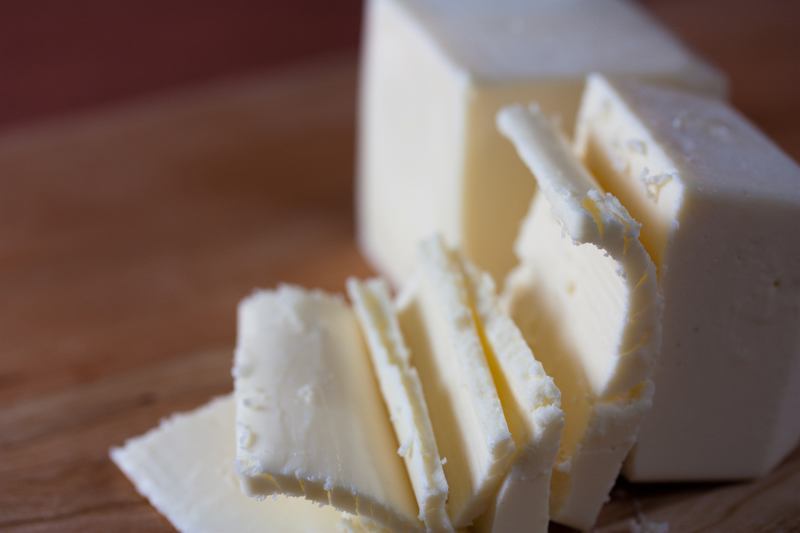
Butter is one of those ingredients that can be so central to baking that as soon as some people hear the term vegan baking they wonder aloud almost in a panic, “what about the butter?!” Many vegan baked items get along great with fats like canola, coconut oil or even olive oil. These types of fats work wonders for cakes, cookies, bars and breads. When designing recipes where we need something to act like butter, things start to get complicated. Solid fats like butter and margarine are integral to things like puff pastry, pie crust, shortbread, croissants, danish dough and certain cakes. This is because in these cases the fat is used to coat the flour so gluten doesn't develop too much and also trap air bubbles to enhance leavening and texture. The only option in these instances is to turn to a margarine or similar vegan butter that is solid at room temperature and gets soft as it melts so it blends to one cohesive mass of dough.
Vegan butter options as of this writing are pretty slim. If you're lucky, you have access to Earth Balance Buttery Sticks or Spectrum Spread (tub margarine is a no-no in baking due to its excessive water and salt content). These margarines utilize a blend of fats, water, starches and gums to mimic real butter. If you're unlucky you only have access to other margarines which use a process called partial hydrogenation to solidify vegetable (usually soy) oil. This hydrogenation process alters the fat structure which also happens to create compounds called trans fatty acids that are highly toxic to the body. Toxic to the point of where finding local, sustainably raised real butter would ironically probably be a better pseudo-vegan alternative in the grand scheme of things.
Non-hydrogenated vegan margarines aren't knights in shining buttery armor either. Lots of them use palm oil which, as of this writing, is currently associated with rainforest destruction due to its rising popularity as regions like Sumatra scramble to devote more land to its production without respecting the environment. Imagine that: a vegan option that actually leads to habitat destruction. There are efforts currently underway to sustainably cultivate palm oil but as vegans know, the best way to really know that you're not contributing to it is to just not buy it.
I've never been a huge fan of margarines because I find that they're so packed with chemicals and stabilizers that they frequently remind me of what it would be like to chew on a candle on a hot day. Have you ever done a taste test with butter and margarine? Butter dissolves away on the tongue and margarine overstays its welcome by a long shot, leaving a gummy residue lingering on. Loving a challenge, I decided to do something about this lack of quality vegan butter and give my best shot to making my own alternative. Lucky for us, this turned out to be much easier than I thought and I think I may have opened a buttery portal to give vegan bakers a little more power to innovate with the flavor of their recipes. Buttery Vegan Shortbread anyone?
I make Vegan Butter in large batches and store it in my freezer. The night before I bake I transfer it to my refrigerator or kitchen counter depending on the consistency my recipe calls for.
Understanding Real Butter
To create Vegan Butter we must understand traditional dairy-based butter. Dairy butter consists of about 78% fat, 18% water and 4% milk solids. In Europe, the fat is usually even higher in proportion to the water. The milk solids are responsible for emulsifying the fat and water, adding additional flavor and allowing the margarine to melt softly. I decided that in order to have a tasty vegan drop-in replacement for butter and margarine in things like laminated doughs and pie crusts, I'd have to stick to these figures. And heck, I'd might as well do my best to make it taste awesome as a spread too.Real butter comes from heavy cream. The fat globules in the cream are completely surrounded and suspended in a network of emulsifying compounds in the water. As you shake the cream, the fats get shaken out of their emulsifying network, find each other and join together. As they join together they start to solidify and the water can be drained away to a point. The result is butter.To create Vegan Butter we must understand traditional dairy-based butter. Dairy butter consists of about 78% fat, 18% water and 4% milk solids.
Designing Vegan Butter
In regards to fat I'd have to use something that's solid at room temperature and not be palm oil due to the environmental issues associated with it. Coconut oil is perfect for this application because it's available refined (unflavored) and unrefined (with coconut flavor intact). Cocoa butter comes in a close second but let's face it- it has an overwhelming chocolate flavor. To capitalize on this, I developed a bonus White Chocolate Vegan Butter. Here's to hoping coconut oil and cocoa butter production don't lead to habitat destruction as their popularity rises.Coconut oil supposedly has health benefits over other fats but as of this writing it really depends on who you talk to. One camp insists that coconut fat is made up of medium-chain fatty acids that are small enough to the point of where they don't get stored as much as other fats and result in quick-burning energy. This camp also insists that the high amount of saturated fat in coconut oil isn't detrimental to health as other saturated fats. The other camp pledges that all saturated fats are bad and should be avoided. I personally think it's too early to say one is right and the other is wrong and happily exercise the everything in moderation approach.
It would be pretty easy to make a fat with the consistency of butter but how would I mimic the flavor without resorting to chemicals? I'm a firm believer in the power of curdling and fermentation. Fermentation and curdling involve hundreds of chemical reactions that produce a multitude of complex flavor compounds with a depth that can't be replicated by chemicals. I know that dairy products like cultured butter and crème fraiche involve a certain level of fermentation; you can even buy the cultures at cheese making stores and make it yourself. I wasn't interested in the complexity of fermenting before mixing my ingredients though. This would probably be more trouble than it was worth. What if I simply curdled non-dairy milk to build the flavor I was looking for?
Non-Dairy Milk Curdling
Curdling involves adding acids to a liquid that causes the proteins to unravel like balls of yarn. As the proteins unravel, their strands line up, join together and tighten. This tightening causes tiny clumps in the mixture and also generates a large array of flavors that add a significant amount of depth to almost anything you bake it with. You may have noticed how much of a fan of curdled non-dairy milk I am due to how often I use it in my recipes on Veganbaking.net.Several weeks prior to these Vegan Butter experiments I conducted tests with different non-dairy milks to see how they vary in curdling in regards to taste. I ended up curdling a half cup of soy, hemp, almond, rice and coconut milks each in 1 teaspoon of apple cider vinegar for 10 minutes, then analyzing thickness and flavor. The results were surprising: soy milk curdled the most and had the most complex flavor (think buttermilk), followed by hemp milk, then almond milk. Coconut milk and rice milk didn't curdle at all. This confirmed my theory that curdling is directly proportional to the amount of protein in the non-diary milk. This makes perfect sense after the explanation of curdling above. This Vegan Butter was going to have to use soy milk. You could probably make a cashew purèe to use for this base if you're not keen on soy, however I haven't tried this yet as of this writing. Banana Vegan Butter doesn't use curdling to build flavor so this is an option for those interested in eliminating soy. It can also be made raw.
TIP: Since curdling is directly proportional to butter flavor development, high-protein non-dairy milks such as soy milk will provide the highest degree of butter flavor in Vegan Butter. Other non-dairy milks can be used, but don't expect the same degree of butter flavor.
Due to this discovery of the flavor-building properties of soy milk curdled with acid, I'll be using soy milk exclusively when I want to build flavor in this manner from here on out.The role of acidity in Vegan Butter
Traditional butter doesn’t really have a noticeable acid profile to speak of. Since we’re building our own butter from the ground up, we need to think about acid’s extremely subtle role in savory, buttery foods. In this case, the acid plays two roles:
It’s responsible for curdling the proteins in the soy milk which creates a layer of savory flavor.
Butter flavor is also enhanced from the acid itself.
After I experimented with several vinegars as well as lemon juice, I originally settled on 100 percent apple cider vinegar to drive butter flavors. This vinegar features malic as well as acetic acid which is a great combination. The malic acid delivers initial fruity notes whereas the acetic acid promotes a volatile cultured butteriness that can be easily perceived in the nose.
One of the problems with malic acid is that it features an initial sharp, acidic punch that quickly fades. This burst of acidity can be a little too much for people who are sensitive to acidity. It wasn’t until later that I discovered the merits of coconut vinegar.
Coconut vinegar lacks the fruitiness of apple cider vinegar but features a smoother acid profile that lingers longer. I found that combining apple cider vinegar with coconut vinegar provides the best combination of subtle fruitiness with a smooth, lingering finish. If you can’t find coconut vinegar, feel free to use 100 percent apple cider vinegar. If you’re particularly sensitive to acidity in general, don’t be afraid to experiment with lowering the acidity to your liking.
Emulsifiers and stabilizers
Now that I had the fat and flavor-building ingredients down, I needed to bring everything together into a smooth cohesive, malleable mass that could be worked into dough, creamed into airy masses for cakes and cut into pie crust dough. Emulsifiers are compounds that bind oil-based ingredients and water-based ingredients into one cohesive mixture. I decided to use soy lecithin for this purpose due to its affordability and effectiveness. Xanthan gum was developed in the mid 20th century from the slimy grime that grows on vegetables in the refrigerator. It so happens that this vegetable gum is a wonder ingredient, acting as both an emulsifier and a stabilizer. A stabilizer is able hold air bubbles and support structure.
Psyllium husk powder
As I’ve learned in the comments section for this Vegan Butter, for one reason or another, some people just aren’t that keen on xanthan gum. For some it’s due to an allergic reaction. Others just aren’t into the idea of eating food that’s not in its natural state. Although I feel that xanthan gum works as an excellent emulsifier and stabilizer in Vegan Butter, I respect those who choose to not consume it.
After some suggestions in the comments and further testing, I’ve found that psyllium husk powder can work as a suitable stabilizer for Vegan Butter.
Keep in mind that if you choose to not use xanthan gum or psyllium husk powder, Vegan Butter will be, as they say in the butter world, less plastic or malleable. This can cause it to be more difficult to work with in some recipes because it’ll shear when cut into recipes instead of squish. It also won't be able to hold air bubbles when whipped.
Fine tuning the salt
I decided to walk a fine line in regards to salt in Vegan Butter. You may laugh at the measurement of ¼ + ⅛ teaspoon salt in the recipe below. I wanted the salt level to be sufficient enough to yield buttery flavor in most applications but not to the point of where it added to the saltiness of baked items.
I ended up fine tuning this formula and the results worked so well I decided to develop variants I now feature in the Vegan Butters recipe section. These variants include Miso Tahini Tarragon Vegan Butter, Three Herbed Vegan Butter, Cultured European Style Vegan Butter and White Truffle Vegan Butter. Use these anywhere you would use traditional butter or margarine. I must say I'm baffled as to why this hasn't been done before and promptly placed on the market. A vegan butter that doesn't use space-age ingredients would surely fly off store shelves, even if it were relatively expensive.
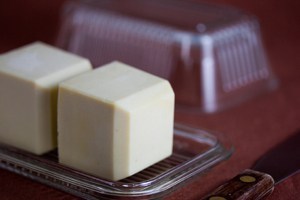
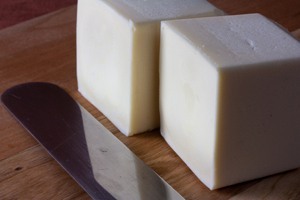
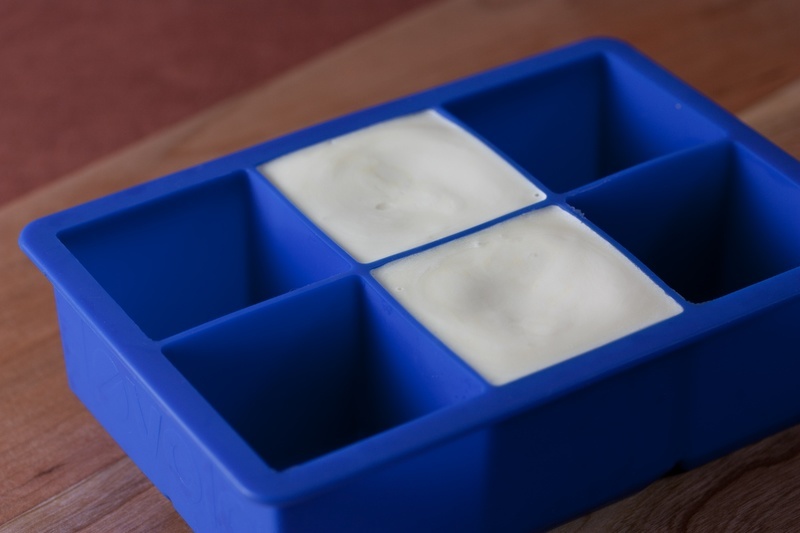
When making these Vegan Butters it's highly recommended that you use a silicone mold like the Tovolo King Cube Extra Large Silicone Ice Cube Tray. This will allow you to make gorgeous butter cubes that can easily be slid out of the molds.
Find out how to make Regular Vegan Butter with Cocoa Butter as a base
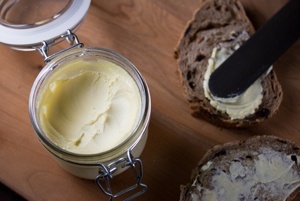
This is regular 'ol Vegan Butter that's designed to mimic your favorite commercial variant. Use it wherever you use butter or margarine. Like traditional butter, Vegan Butter is more solid than tub margarine and not as spreadable. This is so it can perform optimally in vegan baking applications. If your goal is to have a conveniently softer, spreadable Vegan Butter, swap out 1 Tablespoon of the coconut oil with 1 additional Tablespoon canola, light olive oil or rice bran oil.
Regular Vegan Butter Recipe - Coconut Oil Base
Yield: 1 cup (215 grams), or the equivalent of 2 sticks¼ cup + 2 teaspoons soy milk
½ teaspoon apple cider vinegar
½ teaspoon coconut vinegar (if you can’t find coconut vinegar, substitute with ½ teaspoon apple cider vinegar so the total is 1 teaspoon apple cider vinegar)
¼ + ⅛ teaspoon salt
½ cup + 2 Tablespoons + 1 teaspoon (130 grams) refined coconut oil, melted
1 Tablespoon canola oil, light olive oil or rice bran oil
1 teaspoon liquid soy lecithin or liquid sunflower lecithin or 2 ¼ teaspoons soy lecithin granules
¼ teaspoon xanthan gum or ½ + ⅛ teaspoon psyllium husk powder
1) Curdle your soy milk
Place the soy milk, apple cider vinegar, coconut vinegar and salt in a small cup and whisk together with a fork. Let it sit for about 10 minutes so the mixture curdles.2) Mix your Vegan Butter ingredients
Melt the coconut oil in a microwave so it's barely melted and as close to room temperature as possible. Measure it and add it and the canola oil to a food processor. Add the soy milk mixture, soy lecithin and xanthan gum to the food processor. Process for 2 minutes, scraping down the sides halfway through the duration. TIP: Making smooth Vegan Butter is dependent on the mixture solidifying as quickly as possible after it's mixed. This is why it's important to make sure your coconut oil is as close to room temperature as possible before you mix it with the rest of the ingredients.
3) Transfer the Vegan Butter to a mold so it solidifies.
Pour the mixture into a mold and place it in the freezer to solidify. An ice cube mold works well. It should be ready to use in about an hour. Store Vegan Butter in an airtight container in the refrigerator for up to 1 month or wrapped in plastic wrap in the freezer for up to 1 year.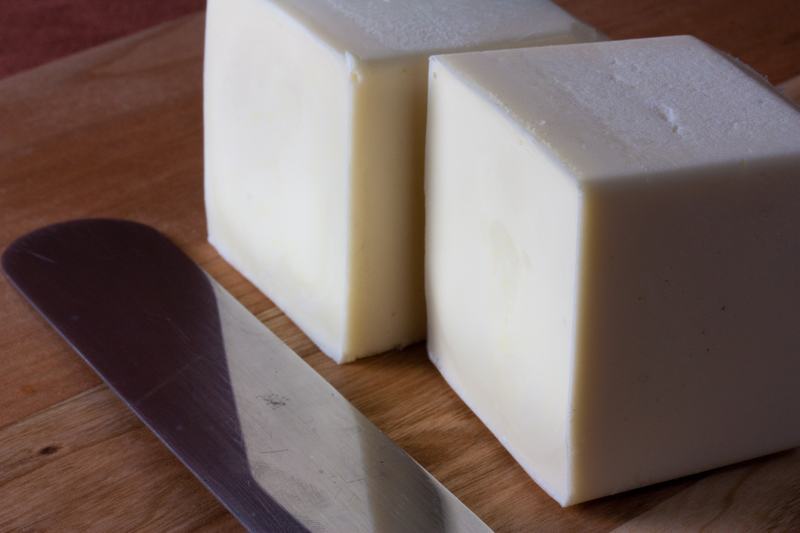
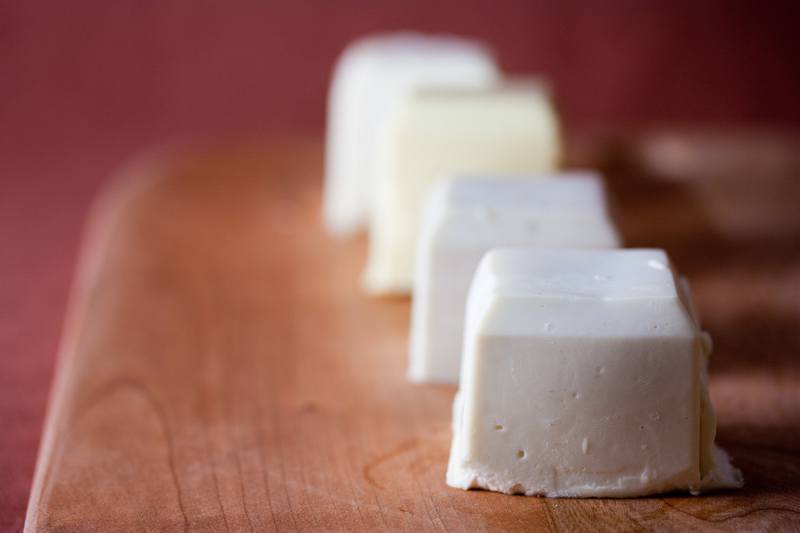
For more Vegan Butter recipes check out the Vegan Butter recipe section.