Veganbaking.net
Vegan Baking Recipes
Fats
Vegan Shortening Recipes
How to Make Vegan Shortening - Coconut Oil Base
How to Make Vegan Shortening - Coconut Oil Base

9
As I progress in my vegan baking adventures I strive for quality ingredients that give me as much control as possible over the flavors and textures I'm trying to convey. I also love breaking foods down to their most basic components and building them back up again, learning and getting unnecessarily excited along the way. For some people it's TV. For me it's this sort of food hacking.
I recently decided that I wanted to create a high quality vegan butter because I began to tire of the store bought yellow goop that I was so steadily relying on. What if I don't want all that diacetyl flavoring, beta carotene coloring, palm oil and who knows what else? My vegan butter experimentation ended up being more successful than I imagined. What if I made my own shortening?
Understanding shortening
What is shortening and why is it used in baking? Shortening is flavorless and consists of 100% fat. It's designed to be used in baking applications where its ability to remain solid at room temperature can benefit the ease of preparation of the food as well as the consistency of the dough.Shortening is frequently used to inhibit gluten formation doughs such as in pie crusts, puff pastry and short bread. Solid fats are commonly utilized in baking to make short doughs. That is, doughs that crumble, flake and crunch. You can think of the term short to mean shortened flexibility. This texture comes about because solid fats enable the following:
- The compounds in wheat-based flours that form gluten; glutenin and gliadin, have trouble binding together and creating structure because they get slippery as they get coated by the fat. This causes the gluten bonds to become blocked partially or completely, depending on the amount of fat present. This is also why adding a couple Tablespoons of any type of oil to a loaf of bread dough will cause the loaf to bake up more soft and tender.
- The fats also repel and displace water, which is needed to activate the glutenin and gliadin into gluten.
- When there are streaks of shortening or other fats in doughs such as pie crusts or puff pastry the fat separates the layers of dough from each other, allowing them to further separate as they trap rising steam and gas during baking. Shortening does this job well because unlike vegan butter which contains water that would activate some of the gluten, shortening is 100% fat so the gluten bonds are minimized as much as possible. This results in crispy, crunchy, flaky goodness. Using a fat that is solid at room temperature such as shortening is critical because a liquid oil would be soaked up by the flour and evenly dispersed in the dough too evenly during mixing which would result in a crumbly, mealy finished product.
- After baking has completed and the baked item has cooled down, the solid fats solidify, adding a sense of dryness to the finished product.
The trick is that you want a certain amount of gluten to be activated by the water added to your recipe so you get your desired texture. More water activates more gluten and downplays the role of the solid fats. Less water activates less gluten and allows more crumbly, flaky goodness to come to the fore in your baked item.
Fine tuning the specific amounts of shortening and water-based ingredients, you can perfectly dial in the perfect level of short dough characteristics. Take a look at any pie crust recipe and you’ll see this delicate ratio of solid fats to water-based ingredients in action.
Applying shortening food science to vegan shortening
It wasn't until I started Veganbaking.net that I realized that the US is one of the only countries in the world where shortening can be easily found. This recipe allows you make shortening if you're unable to find it in your area. It also gives you the option of avoiding regular store-bought shortening which is usually based on palm oil. As of this writing, palm oil is currently associated with rainforest destruction in Sumatra as well as other places. Isn't it ironic that a vegan product can negatively affect environmental and animal welfare? Coconut oil is still flown half way around the world but at least it's a step in the right direction.I recommend refined coconut oil in this recipe. Refined coconut oil has been deodorized by passing it through a filter which removes its naturally occurring coconut flavor and aroma. If you want a strong coconut flavor in your baked item then go with unrefined coconut oil by all means.
One of the most powerful things about making your own ingredients is that you have more control over the outcome. Try using unrefined coconut oil instead of refined to make a true coconut flavored shortening. Then use it in the pie crust you use to make a coconut cream pie. You could utilize this trick anywhere a hidden layer of coconut flavor could enhance your dessert!
A Note of Caution Coconut oil melts at about 77F (25C) so if you're going to be using this shortening in frostings and other preparations where it's not being baked into actual products like pie crust, and the temperature exceeds that temperature, the shortening will melt and your frosting will slide down your cake. If you do need things like frostings to be more temperature stable and similar to traditional frostings, I recommend a version of this vegan shortening that's based on deodorized cocoa butter which is forthcoming.
Learn more about the melting temperatures of fats.
Vegan Shortening Recipe - Coconut Oil Base
¾ cup refined coconut oil1) Melt and mix your fats
Melt the coconut oil in a microwave so it's barely melted and as close to room temperature as possible. Measure it and add it and the canola oil to a food processor. Making smooth shortening is dependent on the mixture solidifying as quickly as possible after it's mixed. This smoothness depends on the fats solidifying before they get a chance to separate. This is why it's important to make sure your coconut oil is as close to room temperature as possible before you mix it with the canola oil.
2) Transfer the Vegan Shortening to a mold and freeze
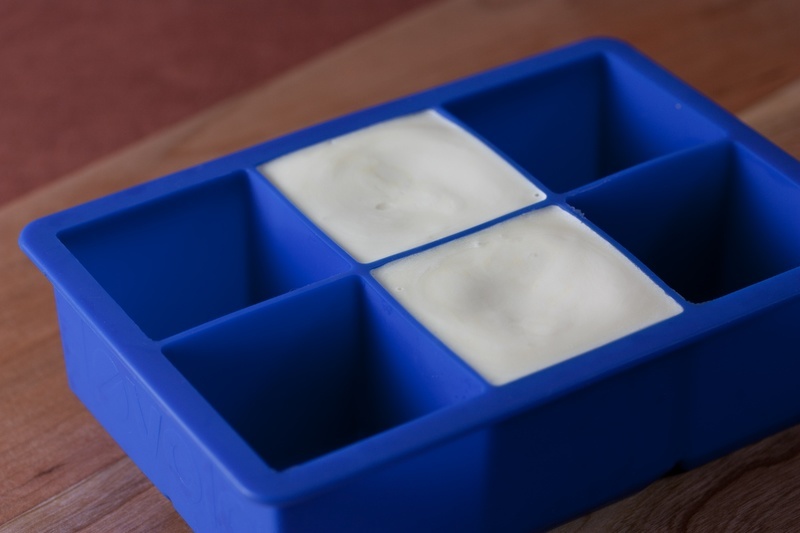
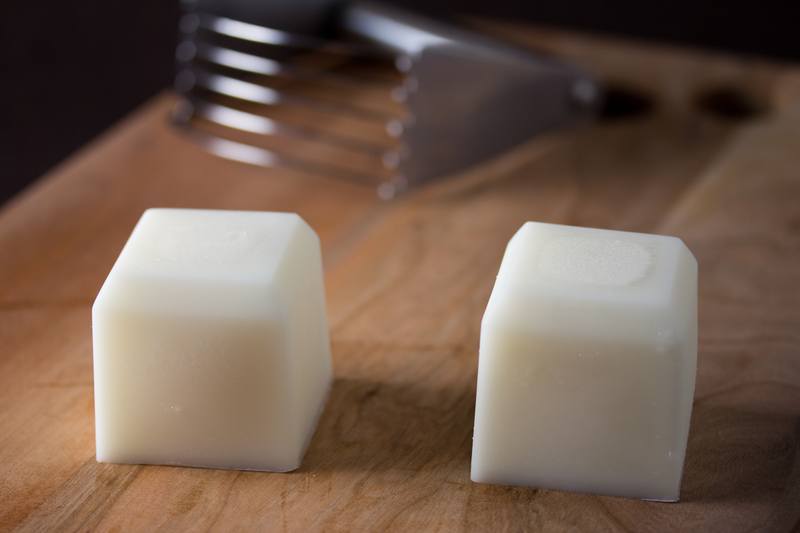
Process for 1 minute, scraping down the sides halfway through the duration. Pour the mixture into a mold such as an ice cube tray and place it in the freezer to solidify. An ice cube mold works well. The vegan shortening should be ready to use in about an hour. Store it in an airtight container in the refrigerator for up to 3 months or wrapped in plastic wrap in the freezer for up to 2 years. This recipe makes 1 cup, 215 grams, or the equivalent of 2 sticks Coconut Oil Vegan Shortening.