Vegan Baking Recipes Vegan Cookie Recipes Pistachio Meringue Cookies

Pistachio Meringue Cookies Mattie

Written by Mattie    
 
5.0 (6)
3
Write Review
Vegan Meringue Cookies

Meringue is a perfect example of how eggs act in traditional baking and how difficult it often is to replace them. When an egg is beaten extensively the proteins contained within it unravel and bind together, trap rising air bubbles, enable ingredients to easily coexist together in a mixture and provide a protein matrix structure that bonds together like rebar in concrete, regardless of moisture content. Traditional meringue involves beating an egg mixture until it has incorporated a large volume of air bubbles, strengthening this mixture so it holds it's shape, adding sweeteners and flavorings then piping and baking it so it slightly leavens and dries to a crisp. Perfectly baked meringue has a delicate crisp that dissolves in your mouth and leaves behind a slightly chewy but not gummy center. I set out to into the annals of food science to create a vegan version. I ended up uncovering a treasure trove of information that can be applied to other vegan baking applications. There's nothing earthy and natural about this meringue. Order your hard to find ingredients online, put on your extra nerdy glasses and let's make vegan meringue!


Stark Discoveries in Starch

How do you remove such a versatile ingredient such as an egg and replace it with something else when making meringue? After all, the majority of a traditional meringue is from the egg. No flax meal here; I knew that a certain ratio of starches, proteins and gums were the only way to go. I decided to start first with the starch.

Vegetable starches come in two main forms: root based such as arrowroot, tapioca and potato starch and grain based such as corn starch, wheat starch and rice starch. Root based starches have higher amounts of amylopectin which, when activated by heat, gel up into a thick, moist goop. Grain based starch has a higher amount of amylose which dries to a tough, rigid form after being activated by heat. Have you ever wondered why people often make wheat paste to glue flyers on outdoor surfaces or why books traditionally have been bound by wheat based glue? The proof is in the pudding! I performed tests with corn starch, wheat starch, tapioca starch and arrowroot starch where I placed 2 Tablespoons of each in a small sauce pan with 1 cup of water and activated the mixture until it was 250F (121C). I then transferred the mixture to a bowl, waited for each batch of starch to cool to room temperature and poked it with my finger to observe firmness. The high amount of amylose in the corn and wheat starches made them the clear winners for what I was going after: a dense, firm gel. No wonder corn starch is the go-to ingredient when breading or crusting things like tofu, tempeh or seitan. The higher amount of amylopectin in the arrowroot and tapioca starch made them too gelatinous to be of any use in a meringue.

Next I had to ensure the starch I was using was as flavor neutral as possible. Since I was planning on using a large amount of starch this was extremely important. I taste tested the corn starch and was surprised to get an intense burst of bitter soapy flavor. I then tasted the wheat starch and did not detect a large amount of off-flavor. Too bad wheat starch is a relatively exotic ingredient. I promptly ordered a large batch of it on the internet. Wheat starch has just secured a permanent spot in my kitchen for future baking adventures.


Building Structure

Beating activated wheat starch didn't change the mixture's consistency at all. Beating unactivated wheat starch in water produced a basic sea foam consistency but failed to develop further; I needed to trap more air bubbles. Xanthan gum is an amazing polysaccharide produced by fermenting a bacteria, Xanthomonas campestris on corn sugar. This is the same bacteria that produces the slimy substance on the vegetables that are starting to go bad in your refrigerator. The difference is that xanthan gum is produced in an otherwise sterile environment so there's no risk of contamination or questionable black slime. Xanthan gum is extremely versatile because it enables ingredients to mix together well, hold onto air bubbles and it provides structure, making it great for foams. Very few vegan ingredients can do all of these things in one fell swoop. After beating a bit to the wheat starch mixture I was soon rewarded with a bowlful of fluffy foam.

I then beat in soy protein isolate to reinforce the structure of the foam. As mentioned above, protein in baking acts like rebar in concrete to bind and secure structure. Cream of tartar was then beaten in to encourage the proteins to further unravel and bind. When making meringue you want to look for what's called the bird's beak which refers to the shape of the foam when you take out one of the beaters and hold it horizontally. I knew I was going in the right direction when I pulled out the beaters to find the bird's beak staring me in the face! I flapped my wings with delight and let out a loud squawk that my neighbors hopefully didn't hear.
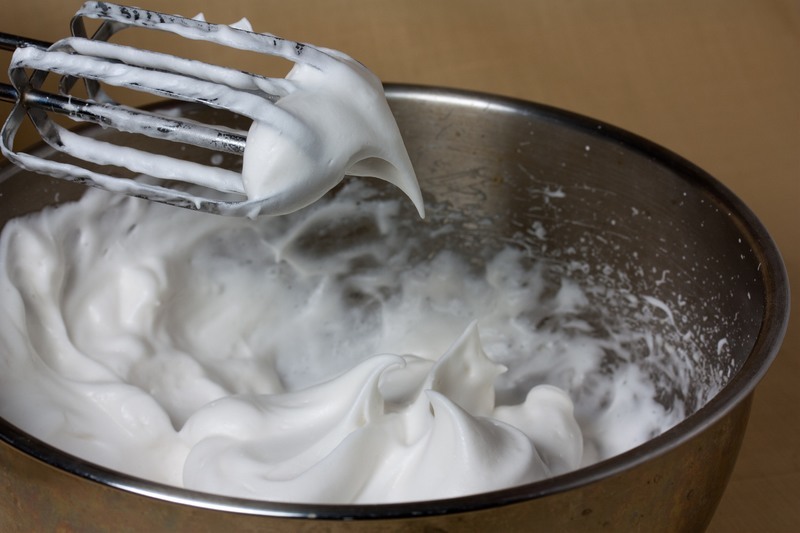
Bagock! Nice Beak You Have There


Meringue Methods

After beating this mixture until it had the optimal ratio of foam to structure I added the sugar and flavorings. This meringue is based on the French method where sugar is beaten in, opposed to the Italian method where simple syrup is beaten in. I got significantly better results with the French method because the simple syrup in the Italian method tended to weigh the foam down excessively.
I've also seen the French method done with confectioner's sugar but in testing I got identical results with granulated sugar so I opted for that route. Confectioner's sugar also contains potato starch which I wanted to avoid introducing into the equation.


Enhancing Flavor

Since traditional meringue is just sweetened dried egg foam it has a tendency to taste bland. Adding caramel sauce and toasted pistachios added much needed flavor depth without inhibiting the consistency of the meringue. After making countless batches using different ratios of ingredients, varying degrees of temperature and an array of different baking times I settled with the recipe below. This meringue is baked about twice as long as traditional meringue because the xanthan gum is so effective at holding onto moisture it needs more time to allow it to dry out. Higher baking temperatures and larger cookie sizes saw the introduction of unwanted large air bubbles in the meringue cookies.
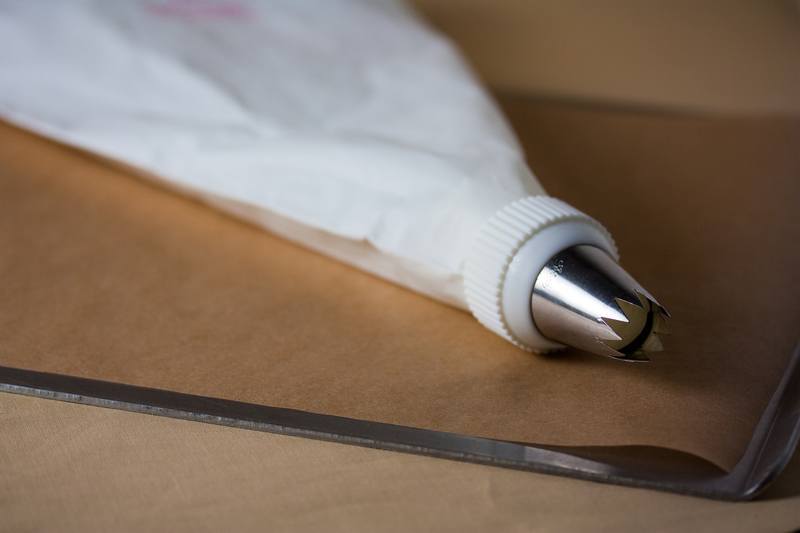
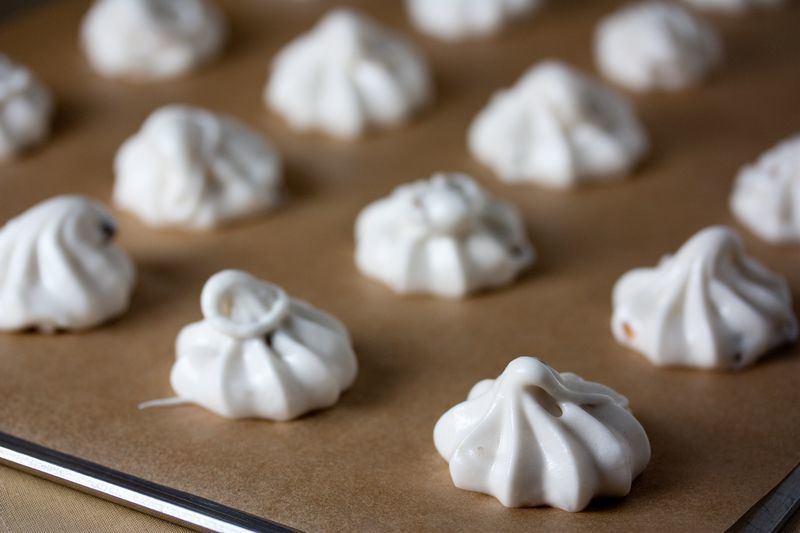
Vegan Meringue Pastry Bag

Vegan Meringue Piped

I attempted to use this recipe and method as a base for angel food cake but so far have been unsuccessful as of this writing, mainly due to the excessive moisture that the xanthan gum holds onto before needing to be baked out.

¾ cup water
¼ cup wheat starch
1 teaspoon xanthan gum

2 Tablespoons soy protein isolate

¼ teaspoon cream of tartar

1 cup sugar
¾ teaspoon vanilla extract
2 Tablespoons Golden Caramel Sauce or Easy Caramel Sauce

1/3 cup toasted pistachios chopped into ¼ inch pieces (chopped in half)

1)
Toast the pistachios. Preheat your oven to 200F (93C). Line two baking sheets with parchment paper.

2)
In a medium mixing bowl add the water, wheat starch, xanthan gum and beat for 1 minute. Add the soy protein isolate and beat for 2 more minutes. Add the cream of tartar and beat for 4 more minutes.

3)
Carefully sprinkle half the sugar into the mixture and continue to beat until incorporated which should take about 30 seconds. Add the vanilla extract and caramel sauce. Reduce the speed to the lowest setting on your mixer and slowly add the remaining sugar. Mix until just incorporated. Now fold in the pistachios.

4)
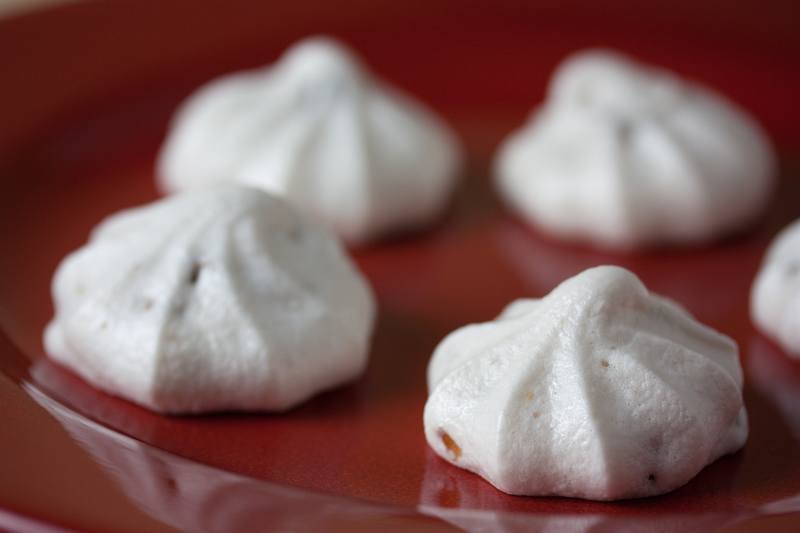
I recommend piping them into 1 ½ inch rounds on a baking sheet using the biggest star tip you can find. I use an Ateco #829 which has a 17mm opening. If you're unable to pipe then use two spoons to arrange about 3 Tablespoons of meringue on the baking sheet about 1 inch apart. Bake for 3 hours and 30 minutes. Store the cooled in an open container at room temperature for up to three weeks. Vegan Meringue Cookies will dry out and become more crisp, losing their chewy centers the longer they sit around.

Get a price on the Soy Protein Isolate I Recommend at Amazon.


Creative Commons Attribution-Share Alike 3.0 Unported


User reviews

Average user rating from: 6 user(s)

Rating 
 
5.0  (6)
Already have an account?
Ratings (the higher the better)
  • Rating
Other Info
Comments
Please enter the security code.
Hi

This is amazing! I always thought that meringues can't be made without eggs. I don't know how good these are. but atleast there is an options for vegan like me.

Now can the same success be repeated with colorfully enticing macarons?
Rating 
 
5.0
Reviewed by Mansi April 29, 2013

can we have the vegan version of macarons?

Hi

This is amazing! I always thought that meringues can't be made without eggs. I don't know how good these are. but atleast there is an options for vegan like me.

Now can the same success be repeated with colorfully enticing macarons?

Was this review helpful to you? 
Would this recipe work for a pavlova and for French macaroons?
Ape Reviewed by Ape April 11, 2013
Top 50 Reviewer  -   View all my reviews (2)

Pavlova and French macaroons?

Would this recipe work for a pavlova and for French macaroons?

Was this review helpful to you? 
If I wanted to use this recipe for meringue to top a pie, would I leave out the sugar and other flavorings and bake it like that? If so, how long would you suggest baking it on top of the pie til it sets like a true meringue?
VikingKev Reviewed by VikingKev March 14, 2013
Top 500 Reviewer  -   View all my reviews (1)

meringue for pie?

If I wanted to use this recipe for meringue to top a pie, would I leave out the sugar and other flavorings and bake it like that? If so, how long would you suggest baking it on top of the pie til it sets like a true meringue?

Owner's reply

This is a really great question VikingKev. I haven't had a chance to really experiment with this meringue on pies. Since it takes so long to bake, I recommend baking it separately on parchment paper then removing it and placing it on the pie after the pie has baked fully, been removed from the oven and cooled. That way you could ensure that both components are baked to perfection. Good luck and let me know how it works out if you get a chance to give it a go!

Was this review helpful to you? 
Have you had an opportunity to try this with rice starch? And have you been able to experiment with any other gums that might be less hydrophilic than xanthan? It would be exciting to come up with a batch that could be used to make a soufflé, either sweet or savory, but you couldn't cook a soufflé for 3 hours! Of course, the interior of soufflé is moist, so perhaps this base would work with one. In any case, thanks for the work you've done so far -- it's really brilliant!

Lena, I think this might work for a pavlova, but you might have to dry the meringue for a much longer time since it's larger. It the small meringues take 3 hours, a pavlova-sized one might be an overnight project! Alternatively, you might think about making mini-pavlovas -- they should dry faster.

Rating 
 
5.0
Reviewed by Rob February 26, 2013

Other Gums?

Have you had an opportunity to try this with rice starch? And have you been able to experiment with any other gums that might be less hydrophilic than xanthan? It would be exciting to come up with a batch that could be used to make a soufflé, either sweet or savory, but you couldn't cook a soufflé for 3 hours! Of course, the interior of soufflé is moist, so perhaps this base would work with one. In any case, thanks for the work you've done so far -- it's really brilliant!

Lena, I think this might work for a pavlova, but you might have to dry the meringue for a much longer time since it's larger. It the small meringues take 3 hours, a pavlova-sized one might be an overnight project! Alternatively, you might think about making mini-pavlovas -- they should dry faster.

Owner's reply

Thanks for the insight Rob! Unfortunately, nothing in the vegan world works quite like xanthan gum in my experience. It's not perfect, but it's the only thing I know of that will hold onto air bubbles long enough to enable a vegan meringue. The tradeoff is that it holds onto water for a really long time too, hence the long, low baking times. It takes awhile to bake off all the water. The texture is marshmallowy if it doesn't bake for long enough.

I can't find food-grade rice starch but I have experimented with rice flour and it doesn't break down enough into small enough particles. I had a good test result with tapioca flour in place of wheat starch for a gluten-free version but it still doesn't get around the xanthan gum and long baking issues. In this recipe the xanthan gum is working like the egg protein ovalbumin would in it's ability to trap air bubbles in suspension.

Was this review helpful to you? 
Thank you for this excellent explanation and recipe. Do you think this recipe could be used to make pavlova?
Reviewed by Lena December 27, 2012

Thank you for this excellent explanation and recipe. Do you think this recipe could be used to make pavlova?

Was this review helpful to you? 
I've made banana creme pie and lemon meringue pie with this as the topping, and it's perfect! It's somewhere between marshmallow fluff and egg meringue, and it toasts beautifully on top. Chemistry for the win!
Rating 
 
5.0
Reviewed by Sean December 22, 2012

Lemon Meringue Pie!

I've made banana creme pie and lemon meringue pie with this as the topping, and it's perfect! It's somewhere between marshmallow fluff and egg meringue, and it toasts beautifully on top. Chemistry for the win!

Was this review helpful to you? 
Mattie —

I stumbled upon this recipe while looking for a way to bake holiday macarons for my vegan and gluten-free relatives. First off, thank you for an amazing base! This really is a versatile recipe, and while the batter is slightly gummier than traditional meringue, it cooks up to be almost indistinguishable. Since I was going for gluten free in addition to vegan, I substituted the same amount of cornstarch for the wheat starch, and it worked like a charm. As you mentioned, there is a bit of bitterness to the cornstarch (not a lot, really), so I made sure to use a strong flavor in my macaron batter to overpower this — namely, chocolate peppermint. Based on your notes about temperature, I cooked the macarons at 200°F, one sheet at a time for an hour each, rotating the sheet after 30 minutes. I then made vegan ganache and piped it into the centers. Voilà! Vegan macarons. As a macaron purist, I lament the fact that they don't have the "foot" that a traditional macaron has, but the flavors and textures are spot on. Thanks again!
Reviewed by Hilary December 21, 2012

Vegan Macarons and Cornstarch Instead of Wheat Sta

Mattie —

I stumbled upon this recipe while looking for a way to bake holiday macarons for my vegan and gluten-free relatives. First off, thank you for an amazing base! This really is a versatile recipe, and while the batter is slightly gummier than traditional meringue, it cooks up to be almost indistinguishable. Since I was going for gluten free in addition to vegan, I substituted the same amount of cornstarch for the wheat starch, and it worked like a charm. As you mentioned, there is a bit of bitterness to the cornstarch (not a lot, really), so I made sure to use a strong flavor in my macaron batter to overpower this — namely, chocolate peppermint. Based on your notes about temperature, I cooked the macarons at 200°F, one sheet at a time for an hour each, rotating the sheet after 30 minutes. I then made vegan ganache and piped it into the centers. Voilà! Vegan macarons. As a macaron purist, I lament the fact that they don't have the "foot" that a traditional macaron has, but the flavors and textures are spot on. Thanks again!

Was this review helpful to you? 
How do you think the unbaked meringue would hold up in a Tom & Jerry batter? I would like to come up with a vegan Tom & Jerry so I can enjoy the same traditions with my family. Thanks for all the research and development on this!!!
Reviewed by Dawn Sullivan December 17, 2012

How do you think the unbaked meringue would hold up in a Tom & Jerry batter? I would like to come up with a vegan Tom & Jerry so I can enjoy the same traditions with my family. Thanks for all the research and development on this!!!

Was this review helpful to you? 
wheatstarch is a by-product of making homemade gluten [seitan] from regular flour. before vital wheat gluten was widely available, the way to make seitan was to make a dough with just water and flour [no yeast or anything else], knead it to activate the gluten, then re-knead it in a bowl of water. the wheat starch would dissolve into the water, and you would be left with a lump of ropy high protein homemade uncooked gluten-- and wheat starch settled at the bottom of the bowl of water. it would be tricky to dehydrate, but since your recipe mixes it with water, you could just use it still as the damp sludge from the bottom of the bowl, probably should put it through a strainer at some point. plus you also have a batch of uncooked seitan to make into dinner. see http://www.ellenskitchen.com/faqs/rawglut.html for details.
Reviewed by nina November 26, 2012

homemade wheat starch

wheatstarch is a by-product of making homemade gluten [seitan] from regular flour. before vital wheat gluten was widely available, the way to make seitan was to make a dough with just water and flour [no yeast or anything else], knead it to activate the gluten, then re-knead it in a bowl of water. the wheat starch would dissolve into the water, and you would be left with a lump of ropy high protein homemade uncooked gluten-- and wheat starch settled at the bottom of the bowl of water. it would be tricky to dehydrate, but since your recipe mixes it with water, you could just use it still as the damp sludge from the bottom of the bowl, probably should put it through a strainer at some point. plus you also have a batch of uncooked seitan to make into dinner. see http://www.ellenskitchen.com/faqs/rawglut.html for details.

Was this review helpful to you? 
This is probably my favourite blog post ever! Can't wait to try your recipe. IF and only if, I can find wheat starch in the UK...
Promise to report back if I do.
Rating 
 
5.0
Reviewed by Vix November 24, 2012

This is probably my favourite blog post ever! Can't wait to try your recipe. IF and only if, I can find wheat starch in the UK...
Promise to report back if I do.

Other Info

Was this review helpful to you? 
I've now made this recipe twice with cream of tartar and following the instructions exactly. However, I still feel my technique of adding the sugar (I try to do it the way you instruct) must be pushing too much air out of the foam.

With the cream of tartar the meringues don't flatten as much as without it, but they are very hard to pipe (since the xanthan makes the mixture so sticky, it's hard to "cut"), they do end up fairly flat and the surface completely loses the wavy piped pattern in the oven. And they still take longer to bake (yes, I have an oven thermometer), perhaps because they're less airy and the water doesn't evaporate as effectively?

They're good but I'm still hoping to make meringues that look like meringues. :->
Reviewed by Maija Haavisto March 15, 2012

Still slight problems

I've now made this recipe twice with cream of tartar and following the instructions exactly. However, I still feel my technique of adding the sugar (I try to do it the way you instruct) must be pushing too much air out of the foam.

With the cream of tartar the meringues don't flatten as much as without it, but they are very hard to pipe (since the xanthan makes the mixture so sticky, it's hard to "cut"), they do end up fairly flat and the surface completely loses the wavy piped pattern in the oven. And they still take longer to bake (yes, I have an oven thermometer), perhaps because they're less airy and the water doesn't evaporate as effectively?

They're good but I'm still hoping to make meringues that look like meringues. :->

Owner's reply

Hi Maija, Thanks for your input! Yes, the meringue utilizes starches and gums ability to trap air bubbles and provide structure instead of egg protein so it has a different consistency as regular meringue before baking- really sticky! Unfortunately, cutting back on the xanthan gum will cause them to lose their ability to hold air.

Also, since gelatinized starches and gums don't provide structure as quickly as egg protein, these meringues will not be able to have a considerable defined structure such as distinctive waves (other than what you see in my pictures). They form into their structures slowly as the starches gelatinize, dehydrate then crystalize.

Due to the varying heat distribution of ovens, if they're still too moist after the allotted time I recommend checking on them in 30 minute intervals. The xanthan gum causes them to hold onto water excessively but it'll eventually let it go as baking time increases.

If you come up with additional vegan meringue tricks please let me know!

Was this review helpful to you? 
thanks for the reply and the link to the soy protein isolate.
I am assuming it's not the same as soy flour, right? What else can it be used for?
And what did you mean about the nougat? Are you experimenting with that too?
I used to love torrone, it Italy, but I stopped eating long time ago...
It would be interesting to try making it a better way...
Thanks,
Daniela
Reviewed by Daniela March 09, 2012

soy protein isolate

thanks for the reply and the link to the soy protein isolate.
I am assuming it's not the same as soy flour, right? What else can it be used for?
And what did you mean about the nougat? Are you experimenting with that too?
I used to love torrone, it Italy, but I stopped eating long time ago...
It would be interesting to try making it a better way...
Thanks,
Daniela

Owner's reply

Hi Daniela, Soy protein isolate is different than soy flour. Soy flour is milled dried soybeans. Soy protein isolate is soy protein that has been isolated from the soy bean in a laboratory setting. It's not the most natural thing in the world and because of that it's not my first choice of ingredients. However, in developing this meringue I needed a protein that wold coagulate and act like egg protein (ovalbumin). Soy protein isolate fits this bill nicely when paired with the other ingredients in this recipe. Soy flour won't work the same way because it's just tiny bits of soy beans- the proteins are too wound up and dispersed within starchy chunks of other pieces of the soybean.

I'd like to work on a nougat recipe in the future but I'm not currently. Let me know if you find one that works well for you!

Was this review helpful to you? 
You are just a genius. I don't even care for, or miss, meringue. But the chemistry lesson alone is worth studying. Some of us were talking recently about how to make the right substitutions in a given recipe. This is great information for veganizing in general. Thank you!
Reviewed by Andrea March 08, 2012

You are just a genius. I don't even care for, or miss, meringue. But the chemistry lesson alone is worth studying. Some of us were talking recently about how to make the right substitutions in a given recipe. This is great information for veganizing in general. Thank you!

Owner's reply

Hi Andrea! I'm not big into meringue either but I just had to make it (now nougat is something I can get behind)! I did a taste test with real meringue and it was indistinguishable. To do this sort of stuff I try to break everything down to its most simple form and find out what's going on food-science-wise. Then I find the vegan equivalent building blocks and build it back up. This one took about 20 tries. it's like a crossword puzzle with food. So glad you enjoy reading it!

Was this review helpful to you? 
I am impressed! One of the fortresses of egg based recipes just fell! I am looking forward to more vegan version of egg based recipes!
Few questions though: what is soy protein isolate and where do we get it. And where do we get wheat starch?
Do you have some specific sources online?
Thanks,
Daniela
Reviewed by Daniela March 08, 2012

Congratulations!

I am impressed! One of the fortresses of egg based recipes just fell! I am looking forward to more vegan version of egg based recipes!
Few questions though: what is soy protein isolate and where do we get it. And where do we get wheat starch?
Do you have some specific sources online?
Thanks,
Daniela

Owner's reply

Hi Daniela! I got the wheat starch at an Asian market. I suspect this recipe would also work with a less exotic starch such as rice flour (non-glutinous) but I have to spend some time on it. I'll be sure to update it when I do.

I added a link below the article on where to get soy protein isolate. Be careful because lots of soy protein isolate products are actually energy drink mixtures with all sorts of other flavoring ingredients thrown in.

Was this review helpful to you? 
Has anyone tried to use this as a base for a vegan macaron (not to be confused with coconut macaroons)? I'll report back when I try it. Works great for the meringue cookie, thanks for posting the recipe!
Reviewed by Tipsy Reader July 23, 2011

Translates to Macaron?

Has anyone tried to use this as a base for a vegan macaron (not to be confused with coconut macaroons)? I'll report back when I try it. Works great for the meringue cookie, thanks for posting the recipe!

Owner's reply

I've been wanting to try this ever since I posted this Tipsy Reader! I haven't had the time (although many unsuccessful attempts at angel food cake) but I'll get to it as soon as this East Coast heat dies down. Let me know how it works out!

Was this review helpful to you? 
Hello! I would love to try to use this meringue as a base to veganize a royal icing recipe that call for meringue powder (such as the one here: http://sweetsugarbelle.com/2011/04/royal-icing-101-or-all-roads-lead-to-rome/ ).
Before I try experimenting I just wanted to ask, have you ever tried using this recipe (or part of it) as a substitute for meringue/meringue powder for an icing base? Any tips or suggestions? Thanks so much!
Rating 
 
5.0
Reviewed by A July 18, 2011

Hello! I would love to try to use this meringue as a base to veganize a royal icing recipe that call for meringue powder (such as the one here: http://sweetsugarbelle.com/2011/04/royal-icing-101-or-all-roads-lead-to-rome/ ).
Before I try experimenting I just wanted to ask, have you ever tried using this recipe (or part of it) as a substitute for meringue/meringue powder for an icing base? Any tips or suggestions? Thanks so much!

Was this review helpful to you? 
I really wanted to make this recipe, but I didn't have cream of tartar (the wheat starch I finally found in Chinatown, it was very cheap). Over here it only seems to be sold mixed with baking powder. I figured that since normal meringues can be made without it, even if it is often used, I would try my luck without it. I added a little extra xanthan, maybe 1/3 tsp. I did get very hard peaks, but when I added the sugar the mixture got a bit runnier (wonder if it was because I didn't use the tartar or because I somehow added the sugar incorrectly)?

I scooped the mixture into mounds on baking paper and baked as per the instructions. It did spread more in the oven, so I ended up with thick cookies instead of meringue shapes, probably because I did not use the tartar (and/or because I somehow failed with the sugar in the previous step). Also, it turns out the centers are still so chewy that they are stuck to the baking paper. Not sure if I'll be able to remove any without breaking them. Damn. So no impressing guests with them. But they are tasty, and just like meringue! (I do plan to try with cream of tartar when I manage to get it.)

I didn't use the pistachios or caramel but instead divided the mixture in two and added vanilla to one and powdered freeze-dried blueberry to the other. The vanilla one tastes just like normal meringue, the blueberry one tastes like, well, blueberry meringue.

I wonder if there is any reason why you couldn't start out with a flavoured liquid like fruit juice. I guess something very acidic would curdle the protein, but something not so acidic, like diluted berry juice?
Rating 
 
5.0
Reviewed by Maija Haavisto June 11, 2011

Yay, meringue!

I really wanted to make this recipe, but I didn't have cream of tartar (the wheat starch I finally found in Chinatown, it was very cheap). Over here it only seems to be sold mixed with baking powder. I figured that since normal meringues can be made without it, even if it is often used, I would try my luck without it. I added a little extra xanthan, maybe 1/3 tsp. I did get very hard peaks, but when I added the sugar the mixture got a bit runnier (wonder if it was because I didn't use the tartar or because I somehow added the sugar incorrectly)?

I scooped the mixture into mounds on baking paper and baked as per the instructions. It did spread more in the oven, so I ended up with thick cookies instead of meringue shapes, probably because I did not use the tartar (and/or because I somehow failed with the sugar in the previous step). Also, it turns out the centers are still so chewy that they are stuck to the baking paper. Not sure if I'll be able to remove any without breaking them. Damn. So no impressing guests with them. But they are tasty, and just like meringue! (I do plan to try with cream of tartar when I manage to get it.)

I didn't use the pistachios or caramel but instead divided the mixture in two and added vanilla to one and powdered freeze-dried blueberry to the other. The vanilla one tastes just like normal meringue, the blueberry one tastes like, well, blueberry meringue.

I wonder if there is any reason why you couldn't start out with a flavoured liquid like fruit juice. I guess something very acidic would curdle the protein, but something not so acidic, like diluted berry juice?

Owner's reply

Hi Maija, Thanks for the great feedback! The cream of tartar allows the protein in the soy protein isolate to unwind and bind more easily due to it being an acid. You may be able to get by with a Tablespoon of lemon juice but the cream of tartar is more exact.

Adding the sugar in stages ensures it doesn't crush the tiny air bubbles worked into the meringue when it's added. When it's distributed into the meringue it actually quickly dissolves and enhances the strength of the bubble network. The meringue stayed extra moist and stuck to the parchment likely due to the increased amount of xanthan gum. That stuff is extremely hydrophilic and just won't let go of water even after several hours of baking when too much is added. The recipe is designed with a specific amount of xanthan gum and baking time that both relate to each other in regards to final moisture content. Let me know how it goes the next time you have cream of tartar on hand. Thanks for sharing!

Was this review helpful to you? 
Will guar gum work instead of xanthan gum? If not, do you know where I can find it?
Reviewed by Sophia May 23, 2011

Xanthan gum

Will guar gum work instead of xanthan gum? If not, do you know where I can find it?

Owner's reply

Hi Sophia, I recommend xantan gum over guar gum because it has a tendency to trap air bubbles the most effectively out most other starches.

Was this review helpful to you? 
Is there a way to decrease the baking time? That seems a little long, especially if you can't fit them all on one baking sheet.Thanks!!
Reviewed by Tipsy Reader February 22, 2011

3 hours?

Is there a way to decrease the baking time? That seems a little long, especially if you can't fit them all on one baking sheet.Thanks!!

Owner's reply

Hi Tipsy Reader, I agree that 3 hours is a little long but here's why: Higher heat levels tend to produce air bubbles in the meringue and cause it to rise and fall excessively. Also, the xanthan gum, which is essential for trapping air bubbles, also holds onto water to the point of where extra baking time is needed to dry it out. This ensures a consistent, crispy meringue with a slightly chewy center.

Was this review helpful to you? 
 
Powered by JReviews